
Is it time to have doula software for your practice?
Your Practice Is Your Baby: Right Tech for Doulas
If you're an independent doula, lactation consultant, or postpartum provider, you're building something that matters to you. You bring your own insights, your lived experience, your training, and your years in this work to every client relationship — and none of that is replaceable.
Over the next few years, how families find and pay for care is going to keep changing fast. New companies, new search tools, and new reimbursement models are here to stay. Many of them are making it genuinely easier for pregnant and parenting people to find care, schedule it, and use their benefits to pay for it. That's good for families. It also means the bar for what a "modern" practice looks like has moved, whether we asked for it to or not.
We've talked with doulas across the country, and we're building a network that solves for the challenges small and independent practices are actually facing. They aren’t often thinking “I need to figure out my software.” They are asking about managing the complexity of client needs and billing/reimbursement and the overfull or way-to-empty calendars - the rollercoaster of feast or famine many of us navigate year after year.
Do I Need Software for My Doula Practice?
If any of this sounds familiar, it's probably time to look at your toolkit:
You've lost a client because of a missed appointment or a scheduling mix-up.
You've struggled to find time on the calendar to coordinate with a backup or practice partner.
You've been driving to a birth in the middle of the night, hunting for a client's address.
You feel a flash of panic when a client asks for a detailed list of visits for reimbursement, or a superbill.
A client has contested a credit card charge for care you already delivered.
You aren’t prepared for a HIPAA-compliant, reimbursement-defined future.
None of these happen because you aren't good at your work. They happen because the systems most of us are running on — a notebook, a shared calendar, a folder of PDFs, a lot of texting — weren't built for how much this work has grown.
Modernizing your practice isn't about adding complexity. It's about:
Securing your clients' personal information the way they now expect.
Making it easy and intuitive for prospective clients to find you, book with you, and pay you.
Staying organized without it living entirely in your head.
Spending less time on the parts of running a practice you don't love.
Being ready for insurance reimbursement and superbills before a client asks.
Scheduling and communicating with practice partners without a dozen back-and-forth texts.
We built software to build relationships, not replace them. The goal is to spend more time with clients and growing your caseload, and less time tracking down an invoice or resending the same email three times. Software should protect the relationship-based, high-touch care that makes this work meaningful — not sit in for it. It should just take the parts of your practice that don't require your hands-on expertise — scheduling, contracts, invoicing, tracking who's paid and who hasn't — off your plate.
When you do have a choice of what to run your practice on, ask more of it. It should help you meet the expectations families now bring to care: clear communication, simple scheduling, secure payment, and the ability to use their insurance benefits. In our first pilot, moving to this kind of platform helped 54% more leads become paying clients — families were more likely to actually book once the process was this straightforward. When we launched our full end-to-end business software, providers earned 30% more within 3 months.
Why Is Okkanti focused on collaboration? The network behind the software
Here's something worth sitting with: too many doulas have empty calendars, and it's not because they aren't excellent at their work. It's because the field is siloed. An agency gets a client request it can't cover, with no reliable way to pass it to someone who can. A doula with three open nights is losing a family that needs seven. A provider on one side of town drives ninety minutes to reach a client, while a provider five minutes away is doing the exact same drive in reverse. Whether it's finding enough clients, or the right clients, our schedules are puzzle pieces that too often don't fit together in a way that sustains a practice.
That's the problem that led us to build more than software: an interconnected network where agencies and independent providers of every size and structure can operate and collaborate.
If you've been wary of anything that looks like "joining a big agency" — worried it means folding your identity into someone else's brand — that's not what this is.
Okkanti doesn't ask you to become part of one organization. We’re the agency-agnostic layer that supports collaboration and we’re the only platform that is centering local organizations already serving their communities.
You keep your name, your pricing, your client relationships, and your local reputation exactly as they are. What changes is that you're no longer working in isolation. You're connected to other providers and agencies who can send you work, absorb your overflow, or fill in when you can't take a case yourself — without anyone giving up their business to get there.
Okkanti is the operating system for the maternal and infant care workforce. The value isn't just the software — it's the network underneath it. That's what makes Okkanti more than software: your partner in the future of your successful practice. It's what gives you the back-end business tools that feel like your own personal team, and the company, backed by the millions in funding it takes to give consumers an easier way to find care.
How to Grow Your Business with Okkanti
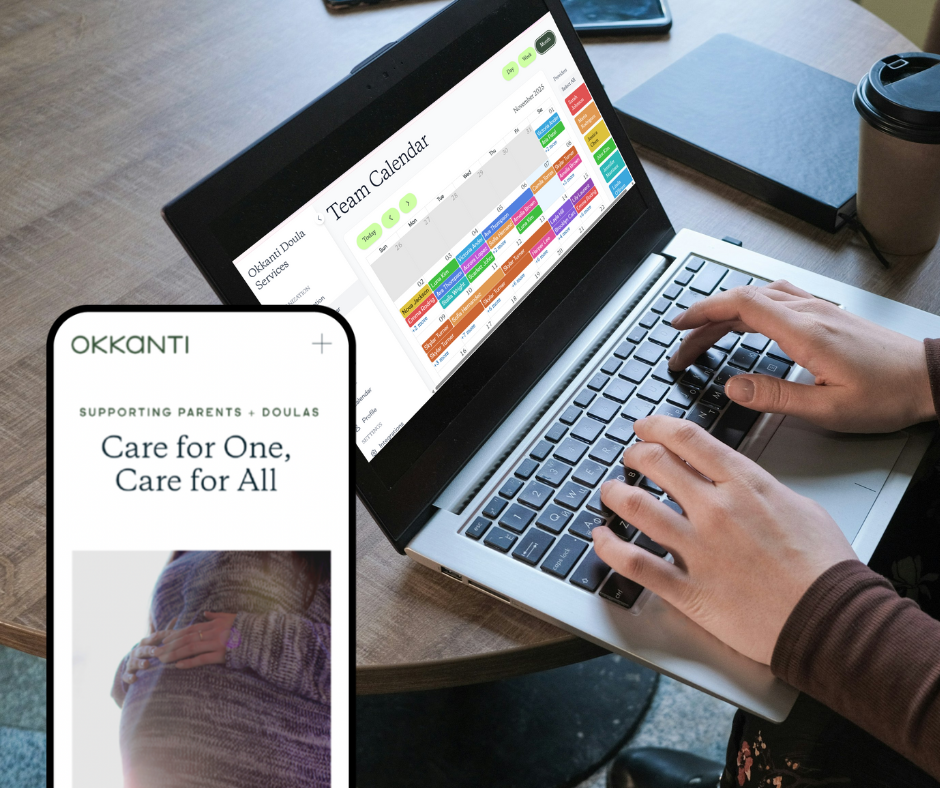
Okkanti’s software helps practice groups of all sizes collaborate- image of team calendar on desktop and mobile friendly view on smartphone
Measure up to what families expect now. Clients want a better and safer way to communicate, schedule, pay, and use their benefits — part of why we helped 54% more leads become paying clients in our pilot.
Manage your leads more effectively. Keep the clients who are the best match for your practice, and route the rest into the network instead of turning them away outright.
Accept leads and referrals from the network. Fill gaps in your calendar with families who are already looking for someone exactly like you.
Make and receive subcontract offers. If you're independent and building your caseload, pick up work with multiple agencies to fill the gaps. If you have capacity, offer it out instead of leaving it unused.
Be ready for reimbursement. If you’ve relied on private pay clients, consider that the number of families who will pay out of pocket will grow smaller as coverage for care increases. It can be daunting but readiness to take insurance or employer-sponsored plans will be critical for providers in 2027 and beyond.
A Word on Reimbursement : your superbill support system
If clients have started asking you for superbills or detailed visit records, you're not imagining a trend — you're seeing where the field is headed. More insurers are covering doula and lactation services, and more families know to ask for the paperwork to get reimbursed. That's good for access to care. It can also be a real burden if you're generating that documentation manually, case by case, with no system behind it.
This is exactly the kind of shift Okkanti is built to help you get ahead of, rather than scramble to catch up with. To make that easier right now: qualifying providers who join by September 1 get 12 months of free superbill and reimbursement documentation — one less thing to build from scratch while the reimbursement landscape keeps moving.
Ways to Join
There's no single "right" way into the network. Depending on where you are in your practice, here's how it usually starts:
You're invited to collaborate. A provider in the network has a client they want to refer to you, or co-manage with you — a postpartum doula looking for an IBCLC, a doula with three open nights matched to a family needing seven, a birth doula lining up backup coverage. Okkanti offers a free trial for the length of the collaboration, so there's no barrier to saying yes. If it goes well and you want to set up your own practice on the platform, schedule a call and we'll walk you through it.
You sign up with your own organization. You get full access to our HIPAA-compliant software, free onboarding, and one-on-one mentorship to help you set up your searchable profile, packages, pricing, forms, and contracts — so your day-to-day can run on autopilot while you manage billing and reimbursements (with claims submission coming soon). Okkanti offers the most affordable approach to high performing software, plus a network most software doesn't come with.
You join an existing organization. Plenty of agencies in our network are actively looking for providers like you. Schedule a call and we'll make introductions to members near you.
However you start, the goal is the same: you keep your independence, and you stop carrying the operational load — and the empty calendar weeks — alone.